
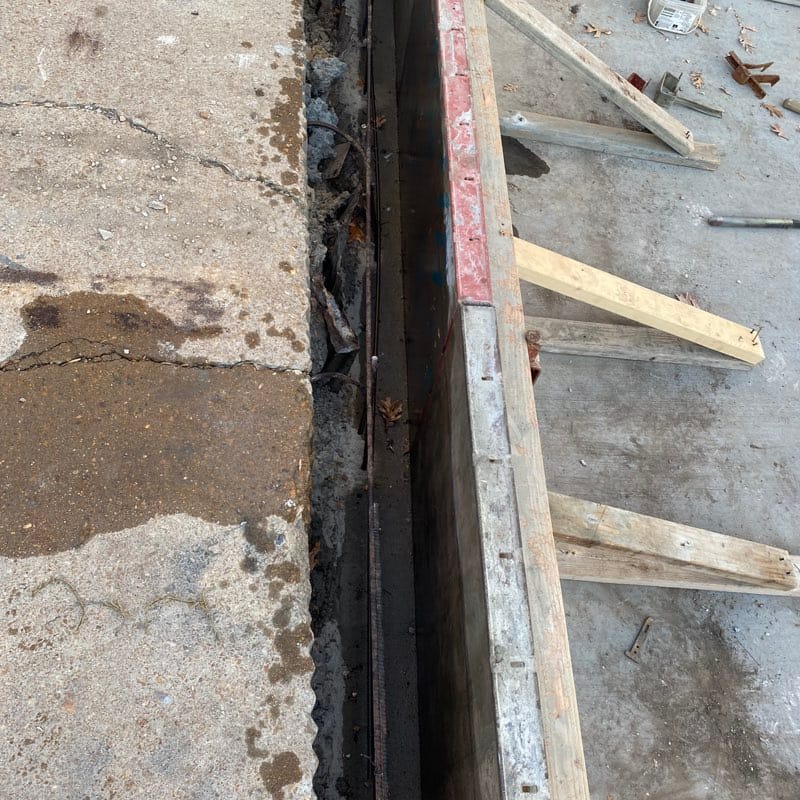
Fiberglass and steel reinforcement both work, and each has a place. Steel rebar and wire mesh are the long-standing choices. Fiberglass (GFRP) rebar is a newer alternative that does not rust. For driveways, patios and similar flatwork, we typically use fiberglass, for reasons we explain below. We also explain where steel is still the right call, because the honest answer is that placement matters at least as much as material.
Why Concrete Needs Reinforcement
Concrete has great compressive strength, so it handles weight well, but it lacks tensile strength. It does not like being pulled or bent. Soil movement, temperature swings and shrinkage all create tension in a slab, and unreinforced concrete cracks. Without reinforcement, the pieces can separate and shift.
Reinforcement picks up that tension. It does not stop cracks from forming. It holds the slab together when they do, keeping the pieces tight and aligned instead of letting one side drop or lift.
Steel Rebar and Wire Mesh
Steel has been the standard for generations. Rebar is a ribbed steel bar laid in a grid; wire mesh is a lighter welded or woven sheet of steel wire. Steel is strong, stiff, familiar to every crew, and can be bent to shape on site. For structural elements such as footings, foundations and walls, steel remains the usual choice and is specified by an engineer.
The weakness is corrosion. When water and de-icers reach steel in a slab, it rusts, and rust takes up more room than the original steel. That swelling pushes outward from within and can crack and flake the concrete around it. In a freeze-thaw climate with road salt tracked onto driveways, that risk is real.
Fiberglass (GFRP) Rebar
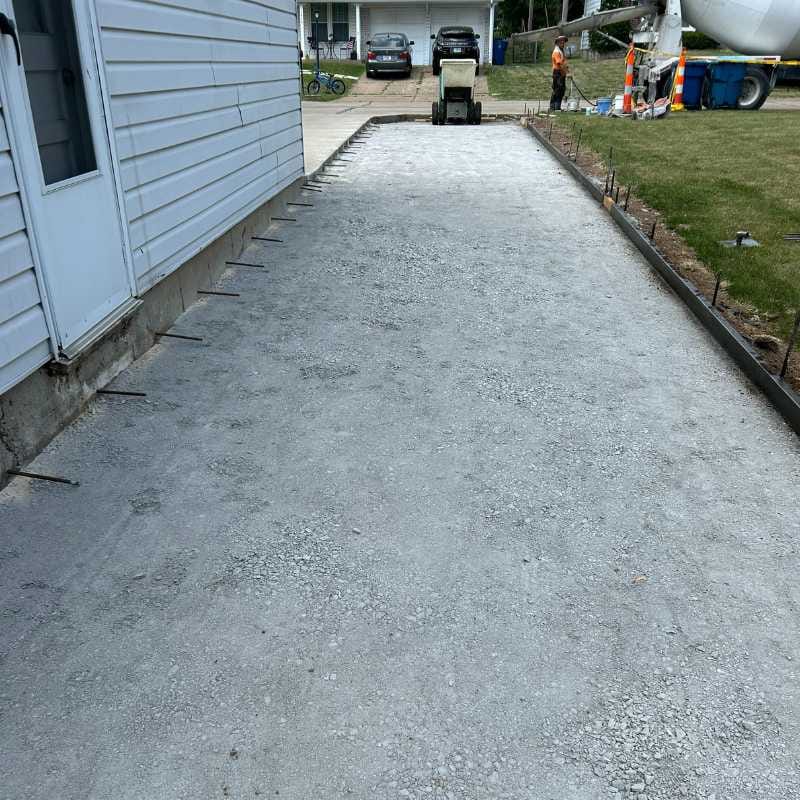
GFRP stands for glass fiber reinforced polymer. Fiberglass rebar is made of glass fibers in a resin, formed into a ribbed bar. It does not rust, so there is nothing inside the slab to corrode and expand. It is also non-magnetic and does not conduct electricity the way steel does.
Fiberglass has tradeoffs too. It is not as stiff as steel, and it does not bend on site; bent shapes are made at the factory. It is cut with a saw or abrasive blade rather than a bar bender. Crews need to know how to handle it and set it properly. GFRP is not limited to flatwork: ACI CODE-440.11-22 covers structural concrete reinforced with GFRP bars, and on structural work an engineer makes that call. For the flatwork we build, we use it for crack control and corrosion resistance.
Weight and Handling
Fiberglass bars are much lighter than steel, which makes them easier to carry and place across a driveway or patio. Steel is heavy and rigid, and it has to be tied into position. Wire mesh comes in flat sheets or rolls that tend to curl and sag, which brings us to the real issue.
Lighter material is easier to position, but it is also easier to knock out of place during the pour. Whichever material is used, it has to be supported so it stays where it was put.
Placement Matters More Than Material
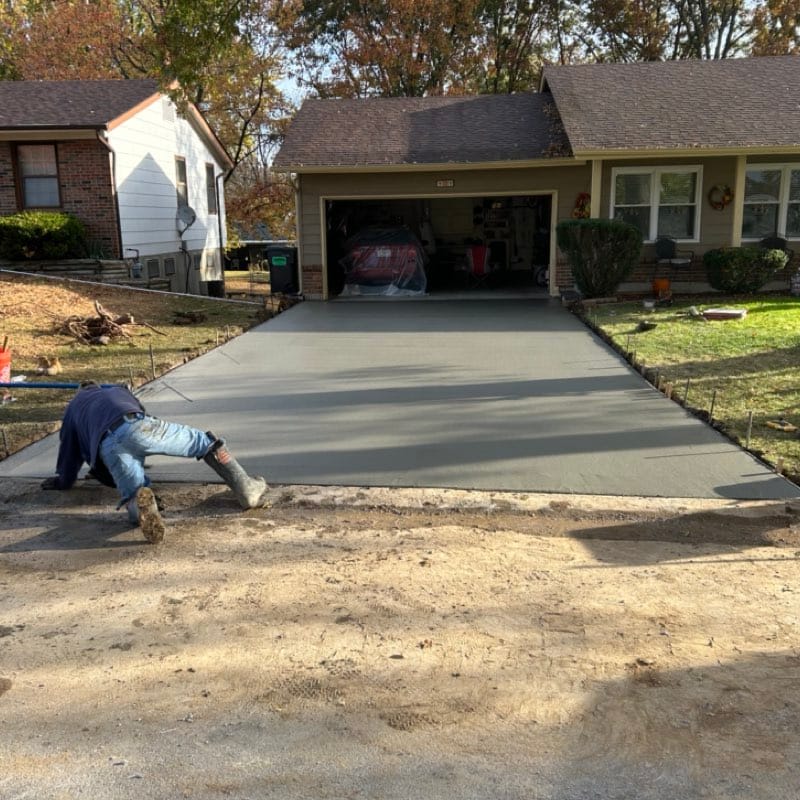
Reinforcement only works when it sits within the slab. A bar or sheet of mesh that is lying on the ground does very little, because the concrete does not surround it and it is nowhere near where the tension is. Reinforcement should be supported on chairs or blocks so the concrete flows around it.
This is why we say the skill is in the setup, not only the material. A properly placed grid of fiberglass will do more than steel mesh left on the dirt, and a well-placed steel grid beats a careless fiberglass one. The base under the slab and the thickness of the pour matter just as much. See our guide to what goes under concrete.
Where Each Fits
Steel is the usual choice for structural work: foundations, footings, walls and anything an engineer designs and specifies. It is also fine in flatwork when it is covered, placed correctly and kept dry enough to last.
Fiberglass makes sense for exposed flatwork that sees water and de-icers, such as driveways, patios, walkways and pool decks. For engineered applications, the American Concrete Institute's ACI CODE-440.11-22 sets requirements for structural concrete reinforced with GFRP bars, so fiberglass can be a structural option when an engineer designs it. If your project is structural, an engineer decides the reinforcement, not us and not a general rule of thumb.
Why We Typically Use Fiberglass
We use fiberglass rebar because it will not rust and expand inside the slab the way steel can. For driveways and patios in a freeze-thaw climate with de-icers, removing the corrosion risk is a sensible choice. It is also lighter and easier to place across a large pour.
We are not claiming one bar replaces another by size, and we do not make equivalence claims between fiberglass and steel sizes. Each job is looked at on its own. When steel is the right material, we will say so.
There is no need to treat either material as a villain. Steel built a great deal of the concrete around us. The question is which material fits an exposed slab in Missouri weather, and what the person placing it will do to get it right.
Questions to Ask About Reinforcement
You do not need to know bar sizes to ask good questions. Ask what material will be used and why it suits your project. Ask how it will be supported so it sits within the slab instead of on the ground. Ask how it relates to the base and the thickness, since the three work as a system.
A contractor who builds carefully will answer without hurry and explain the reasoning in plain language. Be cautious of answers that lean on a single number or a slogan. Reinforcement is chosen for the soil, the use and the loads, and an honest answer includes that.
What Reinforcement Cannot Do
No reinforcement makes up for a poor base, a thin pour or bad drainage. A slab on soft soil will still settle, and a slab with trapped water will still suffer from freeze-thaw. Our guide to why concrete fails covers the causes.
For a driveway, reinforcement is one part of the build. You can see how it fits with the rest on our driveway replacement page.
Fiberglass or steel is only part of the question. Material, placement, base, thickness and drainage work together, and we look at all of them. If you are planning a driveway or patio and want to know what we would put in your slab and why, ask. Bryan or the crew lead will explain it plainly and put it in a written proposal. Estimates are free.
See how reinforcement fits into a full driveway replacement.Driveway replacementQuick answers
Is fiberglass rebar better than steel?
Not in every case. Fiberglass does not rust, which helps exposed flatwork in a freeze-thaw climate. Steel is stiffer and remains the usual choice for structural elements. It depends on the application, and for engineered work an engineer specifies it.
Why does rusting steel crack concrete?
Rust takes up more space than the steel it came from. As steel corrodes inside a slab, it swells and pushes outward, cracking and flaking the concrete around it. Fiberglass avoids this because it does not corrode.
Is wire mesh enough to reinforce a slab?
It depends on where it ends up. Mesh lying on the ground does very little. It needs to sit within the slab, supported so concrete surrounds it. Placement is a common weak point with mesh.
Does fiberglass rebar prevent cracking?
No. It holds the slab together when cracks form, but nothing prevents cracking altogether. Good base, consistent thickness, drainage and control joints all matter as well.
Can fiberglass rebar be bent on site?
No. Bent pieces are made at the factory, and straight bars are cut with a saw or abrasive blade. That is a handling difference crews need to plan for. Steel can be bent on site with the right tools.
Do you use fiberglass on every job?
We typically use fiberglass rebar for flatwork like driveways and patios. We look at each job individually, and where another material suits the project better, we will tell you.