
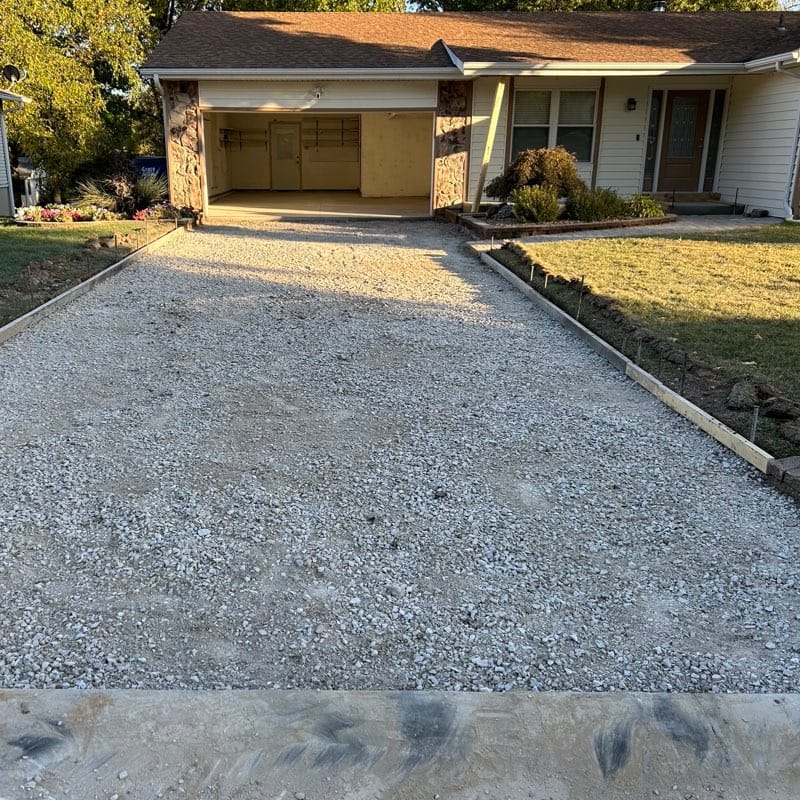
The short answer: a concrete slab sits on prepared soil, a compacted layer of base rock, and usually some reinforcement, and the slab is only as good as what is under it. Most failures we see, a sunken corner, a crack that keeps growing, a puddle that never drains, trace back to the part nobody photographed. Here is what goes under concrete, what each layer does, and how we typically build it at Midwest Hardscapes.
What You Can't See Matters Most
Concrete handles weight well, but it lacks tensile strength, which is why reinforcement matters. It also needs even support. A slab that rests firmly and uniformly on the ground can carry a car. A slab that rests on soft spots, voids or loose fill is bridging gaps it was never meant to span.
That is why the surface is the least interesting part of the job. Anyone can make fresh concrete look good on pour day. The question is how it looks after ten freeze-thaw winters, and that depends on the layers you will never see again once the slab is down.
What you can't see matters most
Five Layers, From the Ground Up
The right base and thickness depend on your soil, how the surface will be used and the loads it will carry. Bryan sets those details for your site, not from a template.
- 01
Prepared subgrade
We excavate and shape the soil so the slab sits on firm, even ground. Soft spots and poor drainage get fixed here, before anything is poured.
- 02
Compacted base rock
A layer of compacted 1-inch minus base rock spreads the load and helps water move away. Skipping compaction is a shortcut that shows up years later.
- 03
Reinforcement
Concrete handles weight well but lacks tensile strength, so we reinforce it. We use fiberglass rebar because it won't rust and expand inside the slab the way steel can.
- 04
The slab
Driveways and patios are typically poured at a consistent 4 inches, with the right mix for how the surface will be used.
- 05
Grading, drainage and joints
We slope the surface so water drains away and plan control joints so that if concrete cracks, it cracks along a line we chose.
The Subgrade: The Soil Everything Rests On
The subgrade is the native soil under the project. Our first job is to remove grass, roots, debris and anything soft, then look at what is left. St. Louis has clay soils that swell when wet and shrink when dry, and clay holds water. A subgrade that is firm and even in one spot and soft in another will settle unevenly, and uneven settlement is how slabs crack and sink.
Where we find soft or disturbed areas, we correct them before building up. Soil conditions differ from yard to yard, even on the same street, which is why we look at your site instead of assuming it matches the last one.
Compacted Base Rock: The Layer That Does the Heavy Lifting
On top of the subgrade goes base rock. We typically use 1-inch minus, which is crushed stone sized to pass through a 1-inch screen, including the finer pieces. That mix packs tight when it is compacted, so it forms a firm, even bed.
The base does several jobs. It spreads the load of the slab and whatever rides on it across a wider area of soil. It gives water a path to drain instead of sitting under the slab. It creates a uniform surface so the slab can be poured to a consistent thickness. And it acts as a buffer when the ground freezes and thaws.
Compaction is the step that matters. Loose rock settles, and when it settles, the slab follows. Proper compaction takes time, and it is the step some contractors rush or skip because the homeowner can't see it afterward. The base makes everything.
Reinforcement: Holding the Slab Together
Reinforcement does not make concrete crack-proof. It holds the slab together when cracks do form, keeping the pieces tight and aligned instead of letting them separate and shift. Fiberglass rebar is what we typically use, because it will not rust and expand inside the slab the way steel can. We compare the two in our guide to fiberglass versus steel reinforcement.
Placement matters as much as material. Reinforcement belongs within the slab, supported so it sits in the concrete rather than lying on the ground. A bar or mesh resting on the base does very little once the concrete is poured around it.
Slab Thickness: Consistency Beats Guesswork
We typically pour driveways and patios at a consistent 4 inches. We say typically on purpose. The right thickness depends on the soil, how the surface will be used and the loads it will carry. A patio with a grill and chairs is a different job from a driveway that sees delivery trucks, and one number is not a universal engineering requirement.
What we care about most is consistency. Thin spots crack first, and a slab that varies from thin to thick behaves unpredictably. Even thickness across the whole pour, with even support below, is the goal. When a surface needs more than our typical thickness, we will say so and explain why.
Grading and Drainage: Where the Water Goes
Water is the biggest enemy of a slab. It softens the subgrade, freezes and expands, and carries de-icers into the surface. A good base helps, but the grading is what tells water where to go.
We shape the surface so water drains away from the house and off the slab instead of pooling. That means paying attention to the slope, to where downspouts discharge, and to where runoff from the neighbor's yard or the street ends up. A beautiful patio that holds a puddle is a patio that will fail early.
Control Joints: Planning Where Cracks Go
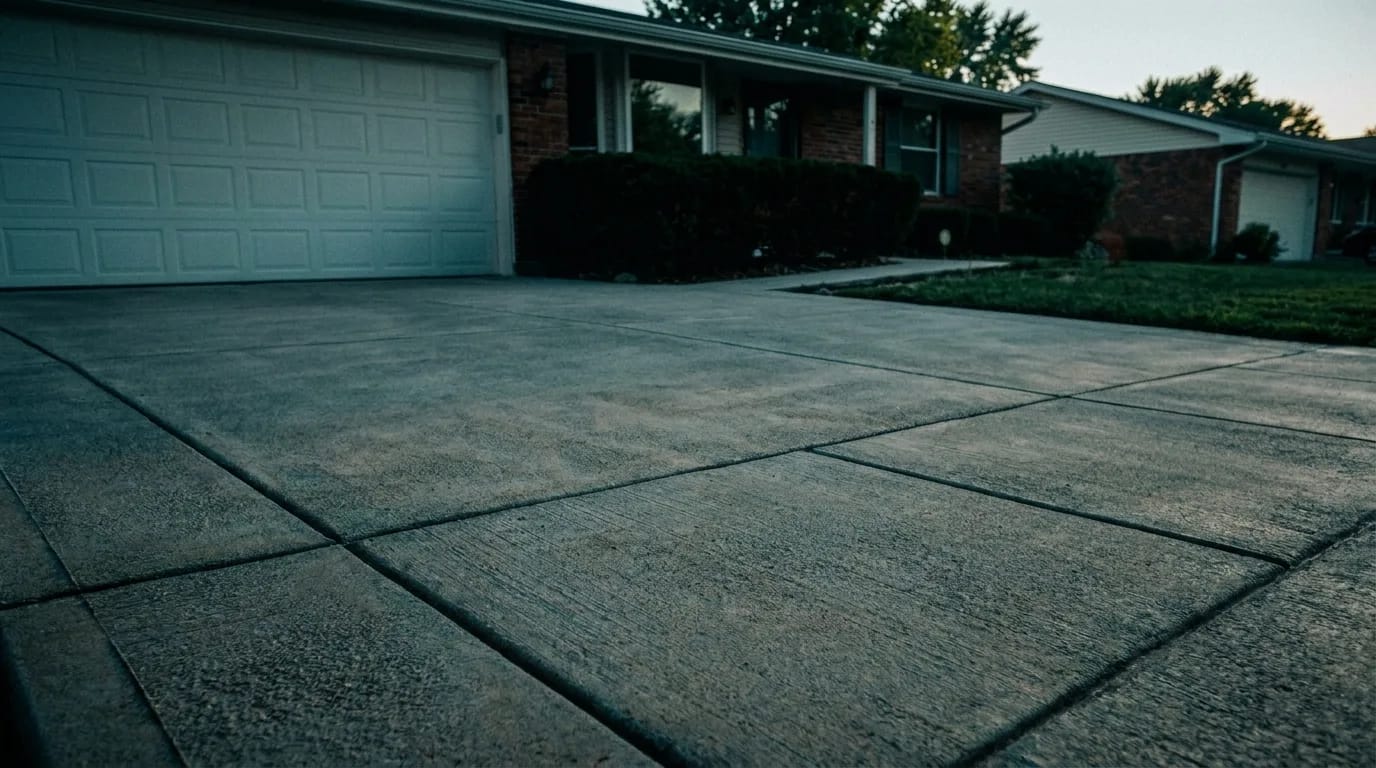
Concrete shrinks as it cures, and it moves with temperature. Because it will move, control joints are cut or tooled into the slab to create planned weak lines. If the concrete is going to crack, it cracks along the joint, where it is straight and easy to live with.
Joint layout is part of the plan, not an afterthought. Missing joints, or joints placed in the wrong spots, are a common reason slabs crack in ugly, random patterns. Spacing and depth depend on the thickness and shape of the pour, so we lay them out for your slab.
Questions to Ask Any Contractor About the Base
You do not need to be an engineer to ask good questions. Before you sign anything, ask what base material will go under the slab and how it will be compacted. Ask what reinforcement will be used and where it will sit in the slab. Ask what thickness is planned and why, and how water will drain.
A contractor who builds it right will answer plainly and without hurry. If the proposal says nothing about what goes under the concrete, that is a reason to ask. See how this plays out on a driveway replacement or a concrete patio replacement.
What you can't see matters most, and the base is where most of the work happens. If you are planning a new slab or want to know why an old one failed, we are happy to look at it. Bryan or the crew lead will walk the site with you, explain what we would build beneath the surface, and send a written proposal. Estimates are free, and getting other quotes is encouraged.
Every driveway we replace starts with the base described here.Driveway replacementQuick answers
What goes under a concrete slab?
Typically, prepared native soil (the subgrade), a compacted layer of base rock, and then the slab with reinforcement in it. The base spreads the load, helps drainage and gives the slab even support. The exact build depends on soil, use and loads.
How thick should a concrete driveway be?
We typically pour driveways at 4 inches, kept consistent across the whole pour. The right thickness depends on the soil and the loads, such as heavy vehicles, so 4 inches is not a universal requirement. We will talk through your situation during the estimate.
What is 1-inch minus base rock?
It is crushed stone that passes through a 1-inch screen, including the finer pieces. That mix compacts tightly into a firm, even bed under the slab. It is the base we typically use for driveways and patios.
Can I pour concrete directly on dirt?
On firm, uniform, well-drained soil it can work. On St. Louis clay, which holds water, swells and shrinks, a compacted rock base is the safer build. Without one, the slab rests on soil that can settle unevenly, which leads to cracking and sunken sections. Good support underneath costs less than redoing the slab.
Does a good base mean the slab will not crack?
No. Concrete can still crack from shrinkage, temperature and loads. A proper base, reinforcement and control joints reduce the causes we can control and keep cracks tight and predictable. Nobody can honestly promise that concrete will not crack.
Why does the base under a concrete slab matter so much?
Because most slab failures start there. Uneven settlement, trapped water and thin spots all come from the layers below the surface. Fixing them later usually means replacing the slab. Doing the base right the first time is the honest way to build.